

Commercial festoon lights bring rows of light to patios, courtyards, and event areas. Start with the space and how many hours you'll use them. Then choose the layout, bulbs, socket stringer, supports, and controls.
This guide helps restaurant, resort, and property teams choose commercial outdoor string lights and plan the work with their installers. Use the ideas to choose the products and work needed before ordering.
Choose the complete lighting system, not just the bulb style you like.
What Are Commercial Festoon Lights?
Festoon lighting uses a cable with spaced lamp holders. The cable and sockets form the stringer. Bulbs fit into the sockets to create separate points of light. You may also see these described as commercial patio string lights or bistro lights.
Explore commercial patio and bistro lights to compare the products for your proposed layout.
Check what each listing includes. A bulb pack is not a complete light string, and a stringer may be sold without bulbs. Mounting parts, supports, and controls may also need to be specified separately.
Plan Summer Lighting for Patios and Venues

Restaurant Patio Lighting and Cafe Seating
Try several rows above a dining area or one around its edge. Keep the pattern tied to the seating plan instead of filling every open space with lights.
Review a sample from a seated position. Check how it looks beside menus, table lights, and nearby windows. Keep required path, work, and emergency lighting separate from the decorative plan.
Resort Terraces and Commercial Courtyards

Choose a few areas to connect, such as a lounge terrace and an adjoining garden. Repeat the bulb style and light tone where that suits the design.
Mark umbrellas, awnings, doors, and staff routes on the plan. Check how each feature moves and where staff need access before placing overhead runs.
Weddings and Outdoor Events
For a wedding or company event, try straight rows or a zigzag pattern over a set area. Match the light tone to the tables, stage, and backdrop.
Set times for installation, testing, and removal. Check each venue. Do not assume one hanging plan will fit every site.
Choose the Layout Before Calculating Quantities
Draw the proposed runs and support locations on a site plan. These layouts are design ideas, not approved support plans.
| Layout | Setting to consider | Decision to resolve |
|---|---|---|
| Parallel runs | A rectangular terrace or dining courtyard. | Number of rows, spacing, supports, and lowest hanging points. |
| Zigzag arrangement | An event patio with suitable supports around its edges. | The actual diagonal routes and attachment locations. |
| Perimeter arrangement | A pergola or defined seating area. | Whether lighting around the edges creates the look you need. |
| Central fan | A venue with a reviewed central support. | Combined loads at the center and access for maintenance. |
Example: Four Spans Across a Patio
Four straight-line spans of 20 feet total 80 feet between the proposed supports. That is not the final stringer order.
Have the installer allow for the planned drape, the full route, leads, endpoints, and permitted connections. Check which complete stringer sections fit that plan. Do not assume a long stringer can be cut to the desired length.
Keep three plans separate: the look, the product order, and the power and supports. Count bulbs from the confirmed socket arrangement, then add agreed spare stock. Check the actual socket count. Do not work it out from the stated length and spacing alone.
Compare Bulbs, Stringers, and Controls

Check the Stringer and Bulb Package
St Nicks lists a 250FT E26 festoon stringer with black wire, 24-inch socket spacing, and 4-inch drops. Bulbs are sold separately.

The S14 Warm White LED Festoon Light Bulbs listing is a 15-piece pack of faceted bulbs, not a complete suspended lighting system.
Ask the supplier to confirm the exact bulb and stringer pairing. These listings do not state every limit needed for a project. Get the product details and installation instructions before ordering.
Choose Appearance and Performance Separately
Choose the bulb shape and finish, then check its light source. Do not treat an Edison-style appearance as the opposite of LED technology.
For a restrained dining area, consider warm white bulbs. Review a sample rather than assuming every product called warm white will look the same.
Check the details below with the supplier and installer:
| Part of the system | What to confirm |
|---|---|
| Bulbs | Shape, finish, size, base, voltage, power use, light output, and permitted location. |
| Stringer | Socket type, spacing, drops, leads, total length, connection limits, and instructions. |
| Power | Supply, connected load, circuit capacity, and protection for the setting. |
| Controls | The required function, product compatibility, and supported load. |
| Supports | Attachment points, span lengths, drop pattern, exposure, and service access. |
Specify Only the Controls You Need
A timer sets operating hours. A dimmer changes brightness. Ask whether the selected lamps support dimming and which controls are approved for them.
Do not assume remote control, color changes, music sync, or smart-home features are included. Name the person who will run the lights and keep a copy of the approved settings.
Where controls need a network, ask what happens when the connection fails. Check the proposed setup before using it across several properties.
Coordinate Garden and Architectural Lighting
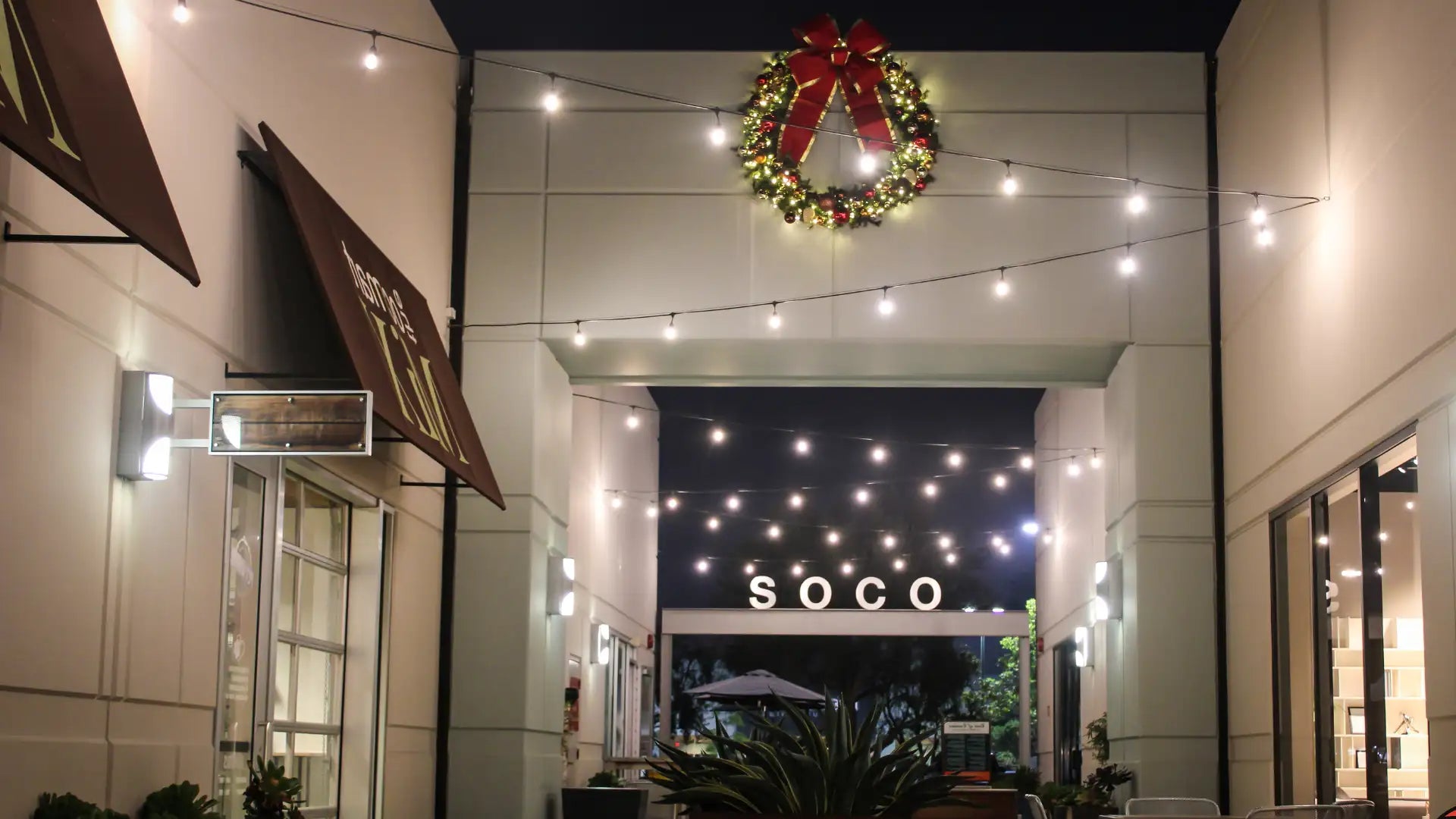
Use festoon bulbs to define the space above a seating or gathering area. Consider mini lights for dense points of light on tree trunks or greenery. Use suitable rope or linear lighting where the design needs a line along a fixed building edge.
Keep these as separate systems. Do not assume bulbs, connectors, or power limits carry across different lighting formats.
For a summer garden, try warm white festoon rows above the terrace with simple mini-light wraps on a few nearby trees. Leave some areas less lit so the main features remain clear.
For a wider product comparison, read the commercial outdoor lighting buying guide. Use it to choose each lighting layer, not to replace the site review.
Review Poolside, Deck, and Overhead Locations
Poolside Areas Need Their Own Review
Do not choose a route over a pool or attach lights to its fence simply because a product is described as weather-resistant. Have a qualified electrical professional review locations near pools, spas, and water features before the layout is approved.
Ask them to confirm permitted locations, equipment, power, and applicable clearances. ESFI's pool and spa safety guidance calls for electrical review against applicable requirements. A general outdoor rating does not settle the poolside design.
Keep Deck Routes and Handrails Usable
Plan lighting on suitable fixed features rather than wrapping required handrail grips. Keep the space needed to use stairs and doors clear. The U.S. Access Board's stairway guidance addresses handrail gripping surfaces and clearances.
Review the full drop of overhead bulbs and the space below them. Include expected movement and access for service. The Access Board's protruding-object guidance covers overhead objects along circulation paths.
Review Trees and Structural Supports
Get approval for each proposed mount. Have a qualified tree-care expert and the installer review any use of living trees. Do not judge a branch's suitability by appearance alone.
Have the installer follow the system's support instructions. Do not pull the electrical stringer tight to remove its sag or use it as an improvised structural cable. The support plan must suit the products, spans, mounts, and site.
Do not use a universal cable gauge, zip-tie method, or maximum span for every project. This guide is not a wiring or rigging plan.
Confirm Seasonal or All-Year Use
Decide how long the system will remain installed. Check its intended use, product markings, instructions, and site approvals before buying.
Outdoor use is not the same as permission to leave seasonal lights installed all year. UL Solutions explains the distinction between seasonal lighting and products evaluated for all-year use.
For a recurring resort program, review permanent versus seasonal lighting. Use that discussion to define the project scope, then verify the actual products.
Plan Installation, Operation, and Maintenance

Review Power and Test Before Opening
Have a qualified electrical professional review the power plan. Use equipment and cords marked for outdoor use in outdoor locations, with GFCI protection. GFCI stands for ground-fault circuit interrupter.
Inspect equipment, match cord ratings to the load, and keep cords clear of standing water. Follow ESFI's outdoor decoration guidance. An extension cord labeled heavy-duty is not a complete power plan.
Keep guests outside the work area during installation and service. Review the finished display by day and after dark. Resolve faults and complete the required site checks before opening the area.
Assign Checks and Replacement Work
Name the person who will check bulbs, sockets, cords, connections, and supports. Set checks around use, weather, and the manufacturer's instructions. Record faults and the actions taken.
Disconnect power before changing bulbs, as ESFI advises. Follow the product's cleaning instructions and use qualified people for work that needs them.
Keep replacement bulbs that match the approved ones. Record the stringer, lamp, controls, and the zone where they are used. Do not accept a substitute based only on shape or color.
Agree on weather-related shutdown rules and who can make that decision. Do not promise that the lights can remain in use in every condition.
For seasonal removal, follow the packing instructions, protect the bulbs, and label each section. Arrange storage through the property or a separate provider. Inspect the system before its next use.
Compare the Full Cost and Review Results
Ask for quotes covering the same scope. Include bulbs, stringers, supports, freight, labor, access equipment, electrical work, controls, energy, repairs, and any removal and storage.
Compare documented power use and planned operating hours rather than assuming every LED option has the same running cost. Do not promise a fixed service life without product evidence.
After opening, review guest feedback, light levels at seating, control use, faults, repair time, and staff effort. Use those findings to improve the plan. Do not claim that the lights alone raised sales or met all site rules.
Commercial Festoon Lighting FAQs
Are Bulbs Included With Every Stringer?
No. Check the exact listing and quote. List bulb quantities, approved replacements, supports, and controls separately where they are not included.
Is a Long Stringer One Approved Span or Power Run?
Not automatically. Overall product length does not establish an allowed span or the length permitted on one power feed. Have the installer verify both for the selected system.
Can Every LED Festoon Bulb Be Dimmed?
Do not assume so. Request dimming information for the exact bulb and confirm a compatible control for the connected load.
Can the Lights Stay Installed All Year?
Only when the selected system, its instructions, and the site requirements allow that use. Confirm this before installation rather than extending a seasonal setup by default.
Plan Your Commercial Festoon Lighting With St Nicks
Send the St Nicks Sales Team your site photos, proposed layout, measurements, operating hours, property location, budget range, and required date.
State whether the lights are for an event, a season, or longer use. Ask the team to confirm suitable products, current lead times, and what the proposed supply or installation scope includes.
Discuss Your Commercial Patio Lighting Project
Updated October 2026
By St. Nick's Christmas Lighting & Decor — La Palma, CA
Commercial holiday lighting and décor supplier since 1998


